

Camila Fontalvo
Housing Innovation & Construction Skills Academy - HICSA
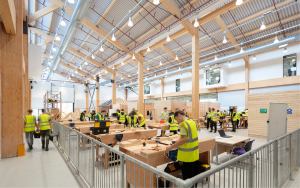
Learning centre for modern construction skills, integrating a restored VictorianLearning centre for modern construction skills, integrating a restored Victorianengine shed with a new build housing specialist workshops and classrooms.Key features include high-performance fabric, light-filled, naturally ventilatedspaces with acoustic attenuation, and low-carbon heating and cooling.
HICSA is located within a wider riverside regeneration area on an industrialsite near the Stadium of Light and a railway line, identified for future retailand residential development. Benefitting from Levelling Up funding, thecollaborative project between MOBIE, the North East Institute of Technology,and Sunderland City Council, delivers a facility for Sunderland College wherethe next generation can upskill in modern construction techniques in abuilding constructed using those same methods. A derelict Victorian engineshed was retained, saving embodied carbon. It was restored and integratedwith the new build, creating a generous double-height main workshop,additional electrical, woodworking (with dust extraction), and plumbingworkshops, and classrooms on the upper floors.
The building’s form, orientation, and layout are driven by environmentalperformance. A sawtooth roof captures north light for comfortable, glarefreeworking conditions while minimising overheating, with south-facingslopes designed to support future PVs. A flat roof between old and new buildaccommodates plant. Daylighting is optimised with a south-facing mesh and additional solar shading to the east and west. High-level clerestory glazingdistributes light deep into interior spaces. Natural ventilation is enabledthrough the layout and an innovative system that carefully coordinates airflowand acoustic attenuation. Quiet areas are located away from the railway.
Reversible air-source heat pumps provide low-carbon heating and cooling,with the building future-proofed for full transition to this technology. The building incorporates advanced lighting control systems and essential fire andsafety systems. External works included lighting, a substation, a bike store,and sprinkler tanks. Comprehensive energy metering ensures accountablemonitoring.
Exposed services, precisely detailed throughout, provide a refined finish thatreinforces the building’s industrial character, sympathetic to the surroundingarea. HICSA combines striking design and educational excellence, reflecting core principles of innovation, technology, and sustainability.
Awards
2025 - IStructE Northern CountiesIStructE Northern CountiesAwards for their structuraldesign, shortlisted
Christ’s College Library
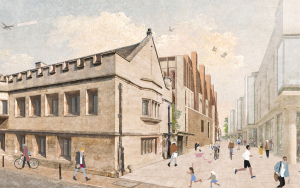
New Library Building and Refurbishment of Kitchen New Library Building and Refurbishment of Commercial Kitchen and Upper Hall within a Grade I Listed Context.
A new four-storey library creates social and study spaces and connects to an adjacent historic building. Sustainable measures include mixed ventilation with MVHR in winter, replacing gas-fired heating with heat pumps and south-facing PVs. The project also upgrades a commercial kitchen to be fully electric.
A new three-storey library creates social and study spaces and connects to an adjacent historic building. Sustainable measures include mixed ventilation with MVHR in winter, replacing gas-fired heating with heat pumps and south-facing PVs. The project also upgrades a commercial kitchen to be fully electric.
Christ's College, just outside Cambridge's medieval city boundary, is replacing its 1974 library with a new three-storey building, offering bright, multifunctional study spaces and a landscaped courtyard. It will connect via a bridge to the Grade I listed 500-year-old college library, while an adjacent 1913 building is refurbished and linked. The project also refurbishes the kitchen and upper hall, enhancing functionality and historic character and supports carbon-neutral goals by 2050 with operational energy below 60 kWh/m²/year, 475 kg CO₂/m², and BREEAM Excellent.
The building is highly insulated and airtight, with daylight maximised through mezzanines, open floors, and atrium voids. In the upper hall, the original roof is exposed to highlight its historic character while improving energy efficiency.
Inefficient plant has been replaced with high-efficiency systems serving the kitchen and upper hall. Rooftop air handling units were removed, with services carefully coordinated through chimney risers in the new library, and kitchen plant relocated indoors to improve aesthetics. In the new library, a mixed-mode ventilation strategy combines mechanical heat recovery in winter with natural ventilation in summer, supported by thermal dampers and chimney return paths. Acoustic design controls internal and external noise from Christ's Lane, with attenuation preventing sound from returning through the plenum. Heating and cooling are provided by air source heat pumps with underfloor and radiant ceiling panels, while fan coil units in the upper hall and library study rooms maintain comfortable temperatures. All gas-fired systems have been replaced with electric alternatives, and the kitchen has been fully electrified with reconfigured washup and hot pass areas. South-facing PV panels further enhance energy efficiency.
Water efficiency is enhanced through rainwater harvesting and a sustainable drainage system, including a rain garden fed by an above-ground collection feature.
The new library is a transformative addition, enhancing the operation of adjacent heritage buildings while creating an inspiring spaces for learning, creativity, and community.
Appleby Blue Wins RIBA Stirling Prize 2025 in a Major Triple Victory
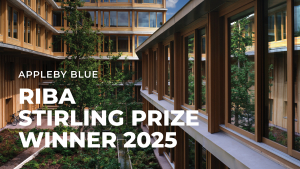
Appleby Blue has been crowned the winner of the Stirling Prize 2025, as part of a significant triple victory.
Widely celebrated for redefining senior living, the older persons’ social housing initiative features spacious homes and comfortable corridors designed for socialising, all around a central water feature, creating the building's unique "sense of a woodland oasis.". RIBA specifically highlighted the project's success in creating an aspirational living environment that stands “in stark contrast to the institutional atmosphere often associated with older people's housing.”
Beyond the Stirling Prize, Appleby Blue also secured both the Neave Brown Award for Housing and the Client of the Year award. The Neave Brown Award, which recognises the UK’s best new affordable housing, honoured Appleby Blue for exemplifying the belief that housing is a civic and social project—one that provides secure social-rent homes while fostering a framework for living well in later life.
Speaking about the project's underlying ethos, Martyn Craddock, Chief Executive of United St Saviour’s Charity, said:
“We are honoured to receive the RIBA Client of the Year Award for Appleby Blue Almshouse... The building’s design enables joyful living in the heart of the city, supports our team to deliver high-quality services, and fosters belonging across generations through the shared community centre and kitchen. This award reflects our shared vision, close collaboration with the architects, and our long-term commitment to the design principles that shaped every decision. We hope Appleby Blue inspires others to reimagine what growing older in our cities can look like — and to create more places like it across the country.”
This marks the first Stirling Prize win for our practice, following four previous shortlists—a true fifth time lucky—moment. We are immensely proud to have been part of the team, helping to shape the project's sustainable, efficient, and comfortable environment.
James A. Nortey-Glover

IMechE ceng, Meng (Hons)
Senior Engineer
James earned a 2:1 Master’s degree in Mechanical Engineering from the University of Bath in 2016 before joining the Mace graduate scheme the same year. He spent two years on-site at the LSE Centre Building, a RIBA National Award winner, overseeing its redevelopment, followed by three years in Mace’s design consultancy and BIM teams. In 2022, he moved to McBains, where he contributed to the mechanical engineering of Staple Tye Harlow, a Passivhaus-certified housing development, and led mechanical and public health engineering for the Arts & Cultural Quarter, Broad Walk, and Market Square in Harlow.
Julie Arnesen

MEng (Hons) CEng MCIBSE
Senior Engineer
Julie earned her MEng in Civil & Architectural Engineering from the University of Bath and became a certified Passivhaus Consultant before joining Skelly & Couch in 2017.
Katharine Scott

MEng (Hons) MSc CIBSE
Principal Building Physics Engineer
Katharine earned her MEng in Civil Engineering from the University of Bristol in 2004, including an Erasmus year at the Institut National des Sciences Appliquées in Lyon, France. She completed an MSc in Environmental Design & Engineering at University College London in 2005 and started working as a Structural Engineer at Ramboll in 2006. In 2012, she joined Skelly & Couch to further her expertise in Environmental & Building Services Engineering, ultimately specialising in Building Physics.
Ightham Mote Visitor Centre
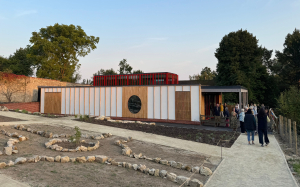
New visitor reception, shop and associated landscape works for the National Trust.
A new, flexible visitor centre and shop, relocated car park, and restored Walled Garden enhance the National Trust's 208ha estate, home to a Grade I listed moated manor house. Sustainable features include an air source heat pump, passive ventilation, and high-performance building fabric.
Ightham Mote, is a Grade I listed moated manor house dating back to the 14th century, set within a 208ha estate in Kent. Surrounded by lakes and woodland the site is managed by the National Trust.
The project aimed to enhance visitor experience by relocating the main car park away from the historic walled garden, expanding overflow facilities, and providing a new reception centre and shop to accommodate growing visitor numbers. A key component of the project involved restoring the historic walled garden to its original purpose.
With a design prioritising flexibility to meet future operational needs, Skelly and Couch provided an environmentally sensitive M&E design for the site through RIBA stage 4.
The visitor centre and shop integrate several passive design measures, enhancing sustainability and comfort. A clerestory maximises natural daylight, reducing the need for artificial lighting, while high-performance building fabric and natural ventilation optimise energy efficiency. Hempcrete walls provide acoustic insulation, thermal regulation, and moisture buffering, further improving the building’s performance.
Sustainable heating is supplied by an air-source heat pump, with energy-efficiency, demand-controlled services and LED lighting further reducing consumption. Low-flow water fittings were also installed to minimise water usage across the site.
This project successfully enhances the visitor experience at Ightham Mote by creating sustainable, adaptable facilities that support the long-term preservation of this historic estate.
Canning Town Old Library
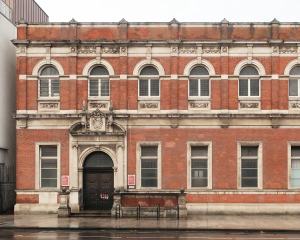
A late-Victorian library converted into an archive and community hub.
Refurbishment and decarbonisation of a Grade II listed Victorian library building into a local archive display and storage area, community hub with a café, flexible event space with support kitchen, and classroom. The roof will house ventilation plant, heat pumps, solar panels, and roof lanterns. Targeting BREEAM ‘Very Good’.
Benefiting from the Council’s successful £40m Levelling Up Fund bid, Skelly & Couch currently work with Haworth Tompkins architects to bring the Grade II listed Victorian building back into public use.
The project focuses on reducing energy consumption through the adoption of low-carbon and renewable energy technologies and aims to achieve a minimum 35% improvement in carbon efficiency compared to current standards, aligning with London's net zero-carbon goal.
The building aims to achieve a BREEAM ‘Very Good’ rating as a minimum.
A fabric first approach to the roof and windows has been taken to ensure excellent airtightness and energy efficient heating while preserving the Grade II listed nature of the building.
Located on a busy road, the building originally faced pollution and high noise levels due to its reliance on natural ventilation. To mitigate these issues and reduce heat loss in winter, three MVHR systems were installed. The new heating system features two CO2 heat pumps, using low global-warming-potential carbon dioxide instead of conventional synthetic refrigerants with much higher GWPs, and achieves high flow temperatures suitable for older buildings previously reliant on boilers.
The new archive is a sealed, environment designed to preserve heritage materials by providing a stable climate. It is not ventilated and remains unheated, relying on the thermal mass of the ground and hygroscopic properties of the materials to maintain stable conditions. Ignition sources have been kept away, all but eliminating fire risk without the need to resort to expensive suppression systems.
Integrating sustainable technologies into this historic library enhances community access to energy-efficient public spaces, preserving architectural heritage and demonstrating how existing buildings can be decarbonised.
Paignton Picture House
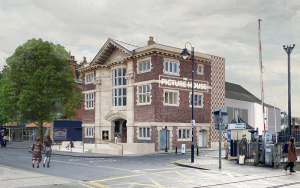
Reinventing one of Europe's first purpose-built cinemas.
Full refurbishment of a historic Grade II* listed cinema in Devon, currently in disrepair; which includes fabric upgrades, completely new services provision to modern standards, updating the auditorium and providing heating through an air-source heat pump.
The Paignton Picture House, a Grade II* listed building and one of the UK's earliest purpose-built cinemas, is centrally located in Paignton next to the railway station. Renowned for its historical significance and association with Agatha Christie, who was a frequent visitor, the cinema operated until the early 2000s before closing as a nearby multiplex opened. The restoration has secured over £4 million in funding. It focuses on repairing and upgrading the building's fabric as well as the auditorium; and it also modernises the services with a low-carbon approach.
To enhance thermal performance while preserving the building's historic character and maintaining breathability, several measures have been implemented. These include retrofitting insulation in the auditorium, which offers a valuable opportunity due to its less historically significant fabric compared to the front of the building. Upgrading the auditorium’s walls, roof, and floors will significantly reduce the building’s overall heating demand. In addition, secondary glazing is also being added in the front rooms where possible to further reduce heat loss and enhance comfort.
An air source heat pump will provide low-carbon heating and cooling to the building, and mechanical ventilation with heat recovery will be installed in the auditorium. All systems will feature demand controls to operate only as needed. Low-flow water fittings are being installed, and photovoltaic panels are being added to the east and west-facing roof pitches to generate low-carbon electricity.
Paignton Picture House restoration marries heritage conservation with low-carbon technologies; honouring the building’s storied past whilst securing its future as a vibrant, energy-efficient cultural landmark.
King's School Canterbury - Rausing Science Centre
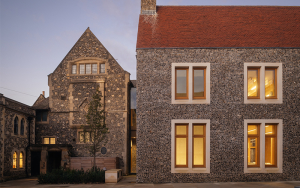
World-class science facilities for a larger student body in the UK’s most historic school.
A teaching block featuring six state-of-the-art physics labs, an auditorium for 140 people, and staff and circulation areas. It connects to refurbished biology and chemistry facilities, fostering interdisciplinary collaboration. It is the first new build on Canterbury's Cathedral precinct since the 1970s.
The King's School Canterbury is an independent, co-educational, day and boarding school located in Kent; located within a site with multiple historic designations including Scheduled Ancient Monument, Conservation Area, Area of Archaeological Importance, as well as World Heritage Site. Nestled in this culturally cherished environment, and with a community deeply invested in preserving the school's heritage, the Rausing Science Centre demanded careful consideration and construction, to integrate modern design with its Grade I-listed surroundings at the Mint Yard in the Precincts.
Skelly & Couch provided services from feasibility to completion, continuing a successful series of commissions with the school. The building sympathetically accommodates the flint and stonework of the new and existing façades. Its first and second floors feature four physics laboratories, the ground floor hosts a flexible science auditorium for teaching and lectures for up to 140 people, and divisible for smaller audiences.
Roman roads were excavated to create a new basement housing two labs, offices, staff and prep rooms, and a boiler room, which houses the building's heating system as well as a new, efficient system for the Grade II Listed Parry Hall, now connected via a glazed link that enhances access and usability of both buildings.The building optimises internal conditions with ample daylighting and natural ventilation, ensuring sufficient fresh air while minimising overheating. This is achieved through strategic openings, thermal mass for passive cooling and deep window reveals that provide shading reducing solar gains. A control system monitors temperature and air quality, enhancing energy efficiency, comfort, and well-being, while the use of LED lighting and low-water-use fittings further contributes to sustainability.
The Rausing Science Centre combines cutting-edge science facilities with the school's rich historical context, fostering collaboration and supporting the needs of a growing student community.