

Camila Fontalvo
Appleby Blue Almshouse
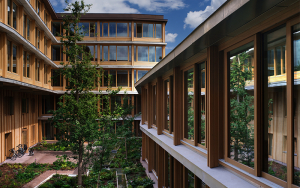
A modern Almshouse for a more connected community.
Older persons’ social housing initiative comprising of 57 extra-care homes with shared facilities like a cookery school kitchen, communal dining spaces, meeting rooms, craft areas, and communal gardens with raised beds for allotment style food production. 2025 Stirling Prize Winner.
Appleby Blue, founded and overseen by the United St Saviour’s Charity in Southwark, is a modern almshouse, a testament to community-focused architecture. Its design targeted a 35% reduction in carbon emissions compared to 2013 Building Regulations.
The building’s fabric was optimised for thermal performance. The layout centres on a communal courtyard garden. Facing the busy A2206, a five-storey northern block houses communal and shared spaces. This positioning makes them visible and easily accessible to the broader community, while also forming a visual and acoustic shield for the garden. A lower two-storey southern block ensures year-round sunlight for the garden and main block. South-facing façades maximise daylight with solar shading to prevent overheating, and thermal mass for passive cooling in warmer weather and at night, helping regulate indoor temperatures.
The building promotes natural ventilation. Double-height communal areas enhance cross-flow, while glazed corridors function as tempered winter gardens, opening in summer to form comfortable spaces to sit and chat.
Below ground, heating, water, and electrical systems run along corridor routes into each flat, with central plantrooms supplying water and heating to local heat interface units for added efficiency. Ventilation is provided by partially centralised roof extract fans serving clusters of flats with automatically controlled airflow. Communal areas feature smart lighting responsive to occupancy and daylight. The building also includes infrastructure for a telecare nurse call system and dual integrated fire systems for residential and commercial zones. Originally designed with CHP, the project evolved over 10 years, transitioning to PV panels that would account for 20% of the building’s carbon reduction through renewable energy.
Appleby Blue reflects a decade-long commitment to sustainable living and community connection, creating a nurturing setting where residents can age gracefully and remain integral to their community.
Awards
2025 RIBA Stirling Prize Winner
2025 RIBA Neave Brown Award for Housing - Winner
2025 RIBA Client of the Year Winner
2025 RIBA National Award Winner
2025 RIBA London Award Winner
2025 Pineapples Award Healthy Homes - Winner
2024 Housing Design Award - Winners of Winners
“We are honoured to receive the RIBA Client of the Year Award for Appleby Blue Almshouse. This project embodies our ambition to support inclusive communities in Southwark through thoughtful, innovative design, and our belief that good design should be available to all. Working closely with Witherford Watson Mann, we’ve shown that historic organisations can be bold and forward-thinking, and that social housing can and should be well-designed and A aspirational.
The building’s design enables joyful living in the heart of the city, supports our team to deliver high-quality services, and fosters belonging across generations through the shared community centre and kitchen. This award is down to the strength and belief in of our shared vision, our very close working relationship with the architects, as well as our joint long-term commitment to the design principles that shaped every decision. We hope Appleby Blue inspires others to reimagine what growing older in our cities can look like — and to create more places like it across the country.”
Martyn Craddock, Chief Executive, United St Saviour’s Charity
RHS Garden Wisley - National Centre for Horticultural Science and Learning
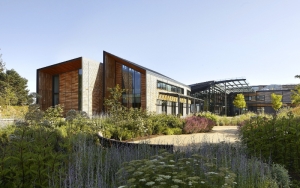
Garden Science Hub with Public Exhibition, Garden Science Hub with Public Exhibition, Members Library and Archive Space.
A 4,700m² hilltop building, featuring a roof terrace at the highest point of celebrated gardens within a significant Green Belt landscape, includes advanced research labs, libraries, and classrooms. Future-proof services for the building, gardens and the wider infrastructure were provided.
The RHS Hilltop development is the UK's first dedicated centre for horticultural and environmental science, featuring research labs, exhibition spaces, libraries, classrooms, an herbarium, and a café.
Skelly & Couch provided energy modelling, environmental design, and daylight and overheating analysis, drawing on experience from projects at the Royal Botanic Gardens, Kew, and Wakehurst Place. Working closely with garden designers, they created a climate-resilient, future-proof infrastructure for the Hilltop gardens and wider site.
The building’s design maximises natural light and ventilation through rooflights, while exposed thermal mass supports passive cooling, and high-specification glazing minimises summer overheating. A sustainable urban drainage system (SUDS) integrates ponds, infiltration trenches, basins, and swales into the landscape, with possible links to an irrigation storage pond.
To mitigate noise from the nearby A3 road, the herbarium archive is enclosed by thick walls, stabilising temperatures, while ground-coupled air ducts and hygroscopic materials further manage humidity, ensuring optimal conditions.
Active design measures further enhance the building’s sustainability, cooling draws on the site's irrigation system, using river and borehole water; and energy-saving features include photovoltaic cells offsetting 10% of the building's carbon emissions, mechanical ventilation with heat recovery, and coordinated power supplies to minimise voltage drop.
Beyond delivering MEP and sustainability services for the new building, Skelly & Couch also designed MEP, SUDs and drainage systems for the surrounding gardens and the wider infrastructure masterplan. The building form created three primary gardens— The Health and Wellbeing Garden (designed by Matt Keightley), The Wildlife Garden and The World Food Garden (both designed by Ann-Marie Powell) —along with smaller teaching and convening spaces.
RHS Wisley creates a sustainable hub for research, education, and community, with a harmonious integration of the building and landscape.
Awards
2021 – Guildford Design Award Winner Public Realm.
2021 – Guildford Design Award Winner Public Realm.
2022 – WAN Awards – Civic Institutes and Community Space Bronze.
2022 – AJ Architecture Award Finalist – Civic projects.
2023 – Civic Trust Award Regional Finalist.
2023 – Selwyn Goldsmith Award Finalist.
2023 – RIBA South East Award Winner.
An AJ Architecture Awards 2022 finalist in the Civic Projects category. A Regional Finalist for both a 2023 Civic Trust Award and a Selwyn Goldsmith Award for Universal Design. Winner of a 2023 RIBA South East Award. See the judges' citation: https://www.ribaj.com/buildings/regional-awards-2023-south-east-wilkinsoneyre-rhs-hilltop-culture-entertainment
King’s School Canterbury – Kingsdown House
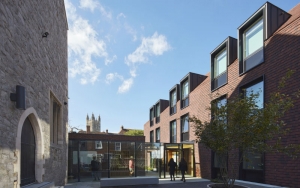
Heritage-Sensitive Phased Refurbishment and New Boarding Accommodation
Phase 1 involved the restoration and refurbishment of the Butterfield Building and Master’s House to create boarding accommodation for 30 pupils, including a common room, quiet study area, and kitchen. Phase 2 introduced a new building for older pupils, achieving a BREEAM 'Very Good' rating.
Located near Canterbury Cathedral, a Scheduled Ancient Monument, the Grade II-listed Butterfield Building, designed by William Butterfield in 1847, was sensitively upgraded and connected to a new boarding house for girls. The project was successfully executed on a rapid timeline, with the facilities required to be operational by the start of the academic year.
The refurbishment included new glazing and insulation to meet modern thermal standards, while the new building featured windows designed to optimise daylight and natural ventilation while minimising heat loss. The structure uses a recyclable steel frame combined with precast concrete planks and a concrete screed to balance thermal mass and lightweight construction, enhancing thermal capacity and reducing overheating.
Drainage was upgraded to HDPE, a more environmentally friendly option compared to PVC or cast iron.
Inefficient heating and lighting systems in the listed building were replaced, significantly reducing carbon emissions, while low-energy systems were implemented in the new building. LED lighting with 'absence control' was installed throughout to ensure lights automatically turn off when not in use. The heating system features automatic central controls, allowing sections of heating and hot water to be turned off when students are absent, while maintaining warmth in staff areas.
Kingsdown House blends modern functionality with heritage sensitivity. The project achieved a BREEAM 'Very Good' environmental rating, all while avoiding intrusive 'green' add-ons that could compromise its historic character.
Awards
2018 Civic Trust Awards – commendation
2017 RIBA South East Awards – shortlisted
2018 Canterbury Society Design Awards: New Building in a Conservation Area
2018 Canterbury Society Design Awards: Refurbishment
2018 Canterbury Society Design Awards: Overall Winner
Command of the Oceans at the Historic Dockyard Chatham
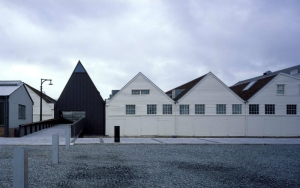
New Build and Refurbishment in a Heritage Context
4.5-hectare heritage public realm and new Discovery Centre for the Grade I-listed Chatham Dockyard. The project achieved major environmental improvements by eliminating heating in large areas and upgrading thermal insulation and building services systems. 2017 RIBA Stirling Prize finalist.
This multi-award-winning project at The Historic Dockyard Chatham preserved key Scheduled Ancient Monuments and the 18th-century HMS Namur timbers. It introduced world-class galleries, interpretation spaces, visitor facilities, a 4.5-hectare heritage public realm, and a Discovery Centre to highlight the dockyard's significance during the age of sail.
This multi-award-winning project at The Historic Dockyard Chatham preserved key Scheduled Ancient Monuments and the 18th-century HMS Namur timbers. It introduced world-class galleries, interpretation spaces, visitor facilities, a 4.5-hectare heritage public realm, and a Discovery Centre to highlight the dockyard's significance during the age of sail.Skelly & Couch provided full mechanical, electrical, public health, and environmental design for the project. Significant energy savings—both carbon and financial—were achieved, crucial to the long-term sustainability of Chatham Historic Dockyard Trust’s strategy. These were realised through enhanced thermal insulation and upgraded building services.
From the outset, the design prioritised environmental conditions to preserve the ship's timbers. The specialist advised maintaining them in their existing condition (as floor joists beneath the floor) without heating or ventilation. To address the thermal and latent loads from visitors, Skelly & Couch developed a natural ventilation strategy.
Undercutting the old timber north and south doors by 50mm allowed cross-ventilation and ensured adequate fresh air. Provisions were made for a future fan installation in the store beneath the link bridge adjacent to the undercroft, to accommodate potential temperature and moisture fluctuations. While the bays above and adjacent to the Namur undercroft are heated, many bays in the mast house and mould loft remain unheated.
Another challenge was concealing containment routes while ensuring future service access would not damage the timbers. For instance, positioning smoke detectors required planning to place supports without disrupting the exhibit.To minimise waste, a proportion of existing cast iron radiators and coolie light fittings were refurbished and reused wherever possible.
The project successfully combined heritage preservation with sustainability, achieving both carbon and financial benefits while safeguarding its historical significance.
Awards
2016 – Civic Trust Conservation Award Regional Finalist.
2016 – Offsite Construction Awards Finalist.
2017 – RIBA Stirling Prize Shortlisted.
2017 – RIBA National Award Winner.
2017 – RIBA South East Regional Award Winner.
2017 – RIBA South East Conservation Award Winner.
2017 – RIBA South East Building of the Year Winner.
2017 – Kent Design & Development Award Winner.
2017 – AABC Conservation Civic Trust Awards Finalist.
2018 – Civic Trust Award Winner.
2018 – RICS South East Best Tourism and Leisure Award Winner.
2018 – RICS Best Project Winner.
Watch a 360 degree interactive video of Command of the Oceans.